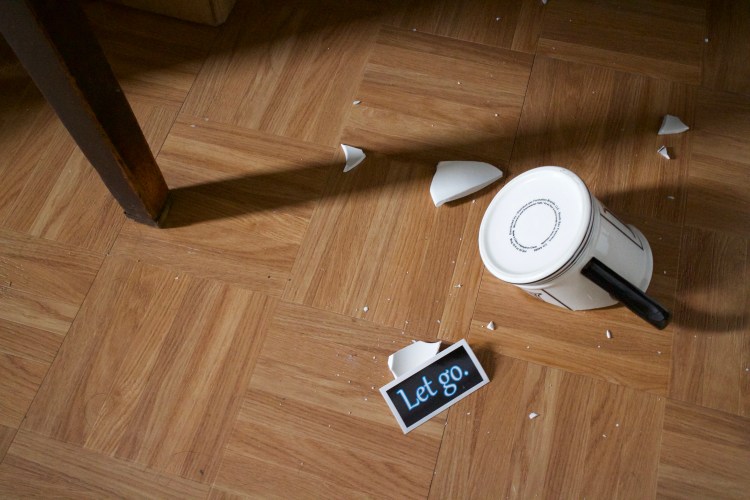
Letting go is a phrase that is often extolled upon us. Most everyone, to some degree, has experienced what this means; most of us by now have let go of something emotionally burdensome from our pasts, even if that thing may not be as highly charged as others.
Yet what is actually happening when we are letting go and how do we actually do it? Anyone who tries to describe how they let go of something will end up unable to describe, in essence, what happened, and that is the way it should be. But we can elaborate a bit more on what is actually transpiring in order to give a better understanding of this everyday imperative, and why it is useful and essential to a healthy wellbeing.
To let go is to gradually put distance between what we are and what we sometimes have. What we are is a life, life itself, and it exists in every moment, perpetually, without worry. What we sometimes have are emotions. Note the use of the word ‘have.’ That is, although we speak in terms of being a specific emotion, i.e. I am angry, I am sad, I am lonely. Such things are in truth not representative of what we are. We hold onto them; they become one’s skin, when they are actually just clothes. What we have also includes experiences, the things that happen to us.
To let go, we sit still and see what is happening to us, in our bodies. We watch the emotions come and go. We observe their fleetingness. Even as they are raging one can view. The more we watch, the closer we look and the closer we look, the more we see. What comes into focus gradually and with patience is that there is some presence inside that is stable while everything else around is moving and in flux. We do not necessarily get caught up in analyzing what this presence is, but we feel it is there.
Crucially, we note the feeling of this presence compared to the highly charged and erratic nature of the emotions we watch. We make a distinction between the two. We may call the former a feeling or an emotion, but we are careful not to muddle the terms since the feeling associated with the former is more of a sensation than an actual emotion. We note the stability of the former, a kind of positive emptiness, compared to the erraticism of the latter.
Here this emptiness, although it may sound of negative connotations is much more full and wholesome than can be deduced. As an example, we can point to a window, as the daoists were fond of doing. The empty space of a window appears to be dependent on some type of frame for its existence; a frame defines an aspect of emptiness, but the emptiness was always there, and is always there. Likewise, in the human person, many things come to frame our presence, but none of them are crucial to that presence being.
Suffering arises because we become attached to the various frames that define how we show up in the world. Emotions happen to us, and we mistake them for life and the sensation of presence. We have experiences that shape us, and we define ourselves accordingly. But then we lose perspective. We come to think that the frames are more representative of who we actually are. We forget that our presence, even when not framed, still is. Letting go means detaching from the frames.
 Existential Conversations